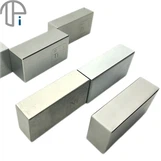
Hey there! I'm a supplier of Gr5 Titanium Bar, and today I wanna chat about the quality standards for this awesome product.
First off, let's understand what Gr5 Titanium Bar is all about. Gr5 titanium, also known as Ti-6Al-4V, is one of the most widely used titanium alloys. It's got a great combination of high strength, good corrosion resistance, and excellent weldability. This makes it super popular in a whole bunch of industries, from aerospace to medical, and even automotive.
Chemical Composition
The chemical composition is a key factor in determining the quality of Gr5 Titanium Bar. For Gr5 titanium, the main alloying elements are aluminum (Al) and vanadium (V). Aluminum usually makes up around 5.5% - 6.75% of the alloy, while vanadium is in the range of 3.5% - 4.5%. These elements play a crucial role in enhancing the strength and other properties of the titanium bar.
Other elements like iron (Fe), oxygen (O), carbon (C), nitrogen (N), and hydrogen (H) also need to be carefully controlled. For example, the iron content should generally be less than 0.4%, and the oxygen content should be within 0.2%. Excessive amounts of these impurities can have a negative impact on the mechanical properties and corrosion resistance of the bar.
Mechanical Properties
When it comes to mechanical properties, Gr5 Titanium Bar has some pretty strict standards. Tensile strength is a major indicator. Typically, the minimum tensile strength of Gr5 titanium bar should be around 895 MPa (130 ksi). Yield strength, which shows the stress at which the material starts to deform plastically, should be at least 827 MPa (120 ksi).
Elongation is another important property. It measures how much the bar can stretch before it breaks. For Gr5 titanium bar, the minimum elongation in a 50 mm (2 in) gauge length is usually around 10%. A higher elongation indicates better ductility, which is important for many applications where the bar may need to be formed or shaped.
Hardness is also a factor. The hardness of Gr5 Titanium Bar is often measured using the Rockwell or Brinell hardness scales. The typical hardness range for Gr5 titanium is around 33 - 38 HRC (Rockwell C scale). This hardness gives the bar good wear resistance and the ability to withstand certain levels of stress without deforming too easily.
Surface Finish
The surface finish of Gr5 Titanium Bar is not to be overlooked. A smooth and clean surface is essential for many applications. For example, in the aerospace industry, a good surface finish can reduce aerodynamic drag and prevent stress concentrations.


The surface should be free from cracks, pits, scratches, and other defects. The roughness of the surface is usually specified in terms of Ra (average roughness). A common requirement for Gr5 titanium bar is an Ra value of less than 1.6 µm (63 micro - inches). This ensures a relatively smooth surface that meets the quality standards for most applications.
Dimensional Tolerances
Accurate dimensions are crucial for Gr5 Titanium Bar. The diameter or cross - sectional size of the bar needs to be within a certain tolerance range. For example, if the specified diameter of the bar is 25 mm, the actual diameter may be allowed to vary within ±0.1 mm depending on the application requirements.
Length tolerance is also important. The length of the bar should be close to the specified length, with a tolerance of perhaps ±5 mm for longer bars. These dimensional tolerances ensure that the bars can be used in various manufacturing processes without causing fitment issues.
Quality Control and Testing
As a supplier, I take quality control very seriously. We use a variety of testing methods to ensure that our Gr5 Titanium Bars meet the high - quality standards.
Chemical analysis is done using techniques like spectroscopy. This allows us to accurately determine the chemical composition of the bars and make sure that all the elements are within the specified ranges.
Mechanical testing includes tensile testing, where we use a testing machine to pull the bar until it breaks and measure the tensile and yield strengths. Hardness testing is also carried out regularly using hardness testers.
Non - destructive testing methods such as ultrasonic testing and magnetic particle testing are used to detect any internal or surface defects in the bars. These tests help us identify and reject any bars that don't meet the quality requirements.
Applications and Why Quality Matters
Gr5 Titanium Bar is used in a wide range of applications. In the aerospace industry, it's used to make aircraft components like landing gear, engine parts, and structural frames. The high strength - to - weight ratio of Gr5 titanium makes it ideal for these applications, where weight reduction is crucial for fuel efficiency.
In the medical field, Gr5 Titanium Bar is used to make implants such as bone plates and screws. The excellent biocompatibility and corrosion resistance of the alloy ensure that it can be safely used inside the human body without causing any adverse reactions.
In the automotive industry, you can find Titanium Bar for Car in high - performance vehicles. The high strength and good fatigue resistance of Gr5 titanium make it suitable for parts like suspension components and engine valves.
If the quality of the Gr5 Titanium Bar doesn't meet the standards, it can lead to serious problems. In aerospace, a faulty bar could cause a component to fail, which could have catastrophic consequences. In the medical field, a low - quality bar used in an implant could lead to implant failure and harm the patient. So, ensuring high - quality standards is of utmost importance.
Comparison with Other Titanium Bars
There are other types of titanium bars available in the market, such as Gr2 Titanium Round Bar and Ti 15333 Titanium Bar. Gr2 titanium is a commercially pure titanium, which has lower strength compared to Gr5 titanium but better corrosion resistance in some environments. It's often used in applications where high strength is not the primary requirement, such as chemical processing equipment.
Ti 15333 titanium bar has its own unique properties. It's known for its high strength and good formability at room temperature. However, its chemical composition and mechanical properties are different from Gr5 titanium, and it's used in different applications, such as in the production of fasteners and springs.
Why Choose Our Gr5 Titanium Bars
As a supplier, we offer Gr5 Titanium Bars that are carefully manufactured and rigorously tested to meet all the quality standards I've mentioned above. We have a team of experienced professionals who are dedicated to ensuring the highest quality of our products.
We source our raw materials from reliable suppliers and use advanced manufacturing processes to produce the bars. Our quality control system is in place at every stage of production, from raw material inspection to the final product testing.
If you're in the market for high - quality Gr5 Titanium Bars, I'd love to have a chat with you. Whether you're in the aerospace, medical, automotive, or any other industry, we can provide you with the right Gr5 Titanium Bars that meet your specific requirements. Don't hesitate to reach out for a quote or to discuss your needs further.
References
- "Titanium: A Technical Guide" by John C. Williams
- ASTM B348 - Standard Specification for Titanium and Titanium Alloy Bars and Billets