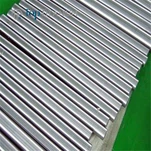
Titanium Bar for Car Introduction
Titanium Bar For Cars have low density, strong corrosion resistance, high specific stiffness and specific strength, good fatigue and creep resistance, and excellent high-temperature mechanical properties. Titanium and its alloys are gradually widely used in the automotive industry. The use of titanium bar reduces the weight of the vehicle body, reduces fuel consumption and increases work efficiency, and provides lower emissions to improve the environment.
1.Introduction of titanium bar for car
Key Benefits:
Weight reduction → lower fuel consumption
Improved efficiency & reduced emissions
Longer lifespan with minimal maintenance
The ideal choice for next-gen, eco-friendly automotive design.
2. Chemical composition of titanium bar for car
|
Grade |
N |
C |
H |
Fe |
O |
Al |
V |
Pd |
Mo |
Ni |
Ti |
|
Gr5 |
0.05 |
0.08 |
0.015 |
0.40 |
0.20 |
5.5- 6.75 |
3.5- 4.5 |
/ |
/ |
/ |
Balance |
3.Mechanical properties of titanium bar for car
|
Grade |
Tensile Strength, Min MPa |
Yield Strength Min MPa |
Elongation in 4D, Min, % |
Reduction of Area, min % |
|
Gr5 |
895 |
828 |
10 |
25 |
4. Core Application Areas and Breakthrough Cases
Engine Components:
Connecting Rod: Weight reduction by 40%, fatigue life > 10⁶ cycles (Case: TC4 connecting rod of a certain automaker has an tensile strength of 950 MPa).
Valves/Turbocharger: Resistant to 650°C high temperature, improving thermal efficiency by 15%.
Body and Chassis:
Impact Absorbing Beam: Energy absorption efficiency increased by 50% (Case: Weight reduction of 150 kg in the body of a high-end electric vehicle).
Suspension Arm: Utilizing Ti-13Nb-13Zr superelastic alloy, impact resistance increased by 30%.
Exhaust System:
Muffler and Exhaust Pipe: Sulfur corrosion life > 10 years.
5. Advances in Advanced Manufacturing Processes
Additive Manufacturing (AM):
SLM/EBM Technology: Directly form complex structures (such as F1 racing car chassis inserts, with a wall thickness of 1 mm), weight reduction by 30%.
Heat Treatment Innovation:
High Pressure Heat Treatment (HPHT): Simultaneously achieve hot isostatic pressing (HIP) and solution stress relief (STA), fatigue strength ↑ to 790 MPa (N = 10⁷).
Low-Temperature HIP Process: Fine-grain α layers at 820°C/200 MPa, balancing strength (950 MPa) and defect repair.
6. Why choose titanium bar for car
Titanium bar have excellent fatigue limit performance and significant bending fatigue strength load, extending their service life. It has strong corrosion resistance, does not require surface treatment or additional rust prevention, has strong anti-corrosion performance, long service life and does not require replacement. Beta titanium alloy for automobiles is easy to process, with simple equipment, low density, 60% -70% lighter than steel, and excellent fuel consumption performance.
7.Applications of titanium bar in car
Titanium and alloys can be used in household cars to reduce vehicle weight, improve efficiency, and reduce emissions. The available components include engine, suspension system, transmission parts, shock absorbers, mounting ear nuts, bolts, lever fasteners, parking brackets, driven shafts, dowels, etc. Ti-6Al-4V alloy can be used to manufacture clutches and pressure plates. The global automobile production is expected to exceed 77 million vehicles by 2015, with China accounting for 40%, approximately 30 million vehicles. Each car uses 1 kilogram of titanium components, and the global automotive titanium will reach over 77000 tons, with China reaching nearly 30000 tons. This will be a huge market

01
Weight reduction
Better fuel efficiency & lower emissions
02
Key applications
Weight reduction (vs steel) → Better fuel efficiency & lower emissions
Key applications:
03
Global Market
77M+ vehicles →
77K+ tons titanium (1kg/car)
04
China Market
30M vehicles (40% share) → 30K tons titanium
Hot Tags: titanium bar for car, China titanium bar for car manufacturers, suppliers, factory, Gr9 Titanium Bar, Ti 62222 Titanium Bar, Gr23 Titanium Bar, F136 Titanium Bar, B348 Titanium Rod, Forged Titanium Stepped Hollow Shaft