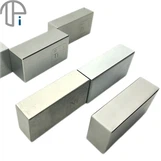
Hey there! I'm a supplier of forged titanium bars, and I often get asked if these bars are suitable for automotive applications. Well, let's dive right into it and find out.
First off, let's talk about what forged titanium bars are. Forging is a manufacturing process where metal is heated and then shaped using compressive forces. This process gives the titanium bar a really strong and uniform internal structure. Titanium itself is an amazing metal. It's super lightweight, has high strength, and is extremely corrosion - resistant. These properties make it quite appealing for a whole bunch of industries, including the automotive world.
One of the biggest advantages of using forged titanium bars in automotive applications is weight reduction. In the automotive industry, every little bit of weight reduction counts. Lighter vehicles are more fuel - efficient and have better handling. Titanium has a density that's about half of steel, so replacing steel components with titanium ones can lead to significant weight savings. For example, if you use a forged titanium bar in the engine or suspension system, you can cut down on the overall weight of the vehicle without sacrificing strength.
Another great thing about titanium is its high strength - to - weight ratio. This means that even though it's light, it can still handle a lot of stress. In automotive applications, components are constantly under stress from vibrations, acceleration, and braking. A forged titanium bar can withstand these forces without deforming easily. For instance, in high - performance cars, titanium bars can be used in the connecting rods. Connecting rods are crucial parts that transfer the force from the pistons to the crankshaft. With a forged titanium bar, they can operate more efficiently and reliably, especially at high engine speeds.
Corrosion resistance is also a major plus. Automotive components are exposed to all sorts of harsh environments, including road salt, moisture, and chemicals. Titanium has a natural oxide layer on its surface that protects it from corrosion. So, if you use forged titanium bars in parts like exhaust systems or chassis components, they'll last longer and won't need to be replaced as often due to rust or corrosion.
Now, let's talk about some specific types of forged titanium bars that could be used in automotive applications. One popular option is the Ti 6246 (Ti - 6Al - 2Sn - 4Zr - 6Mo) Titanium Alloy Bar. This alloy is known for its excellent high - temperature strength and creep resistance. In automotive engines, where temperatures can get really high, this type of titanium bar can maintain its mechanical properties. It's also quite ductile, which means it can be easily formed into different shapes during the manufacturing process.
Another option is the Ti 1023 Titanium Bar. This alloy has good fracture toughness and is suitable for applications where there's a risk of impact or sudden loading. In automotive suspension systems, for example, components need to be able to handle sudden shocks from bumps on the road. The Ti 1023 titanium bar can provide the necessary toughness and durability in such situations.
However, it's not all sunshine and rainbows when it comes to using forged titanium bars in automotive applications. One of the main drawbacks is the cost. Titanium is generally more expensive than steel or aluminum. The forging process also adds to the cost. So, for mass - produced, budget - friendly cars, using titanium bars might not be economically viable. But for high - end, luxury, or high - performance vehicles, the benefits often outweigh the cost.
Another challenge is the machining difficulty. Titanium is a hard metal, and it can be tricky to machine into the precise shapes required for automotive components. Specialized tools and techniques are needed, which can increase the manufacturing time and cost.
There are also some concerns about the compatibility of titanium with other materials. In automotive applications, different metals are often used together. Titanium can react with some other metals, causing galvanic corrosion. So, when using forged titanium bars, proper insulation or coating might be required to prevent this from happening.


Despite these challenges, the automotive industry is gradually starting to embrace the use of forged titanium bars. As technology advances and production methods become more efficient, the cost of titanium is likely to come down. And with the increasing demand for more fuel - efficient and high - performance vehicles, the market for forged titanium bars in automotive applications is expected to grow.
If you're in the automotive industry and are looking for high - quality forged titanium bars, I'm here to help. Whether you're working on a high - performance sports car or a more mainstream vehicle, I can provide you with the right type of forged titanium bar for your specific application. We have a wide range of products, including the ones I mentioned earlier, like the Ti 6246 (Ti - 6Al - 2Sn - 4Zr - 6Mo) Titanium Alloy Bar and Ti 1023 Titanium Bar. We also have Titanium Bar for Petroleum, which might also have some potential applications in the automotive field, especially in fuel - related components.
If you're interested in learning more about our forged titanium bars or want to discuss a potential project, don't hesitate to reach out. I'm always happy to have a chat and see how we can work together to meet your automotive component needs.
In conclusion, while there are some challenges associated with using forged titanium bars in automotive applications, the benefits in terms of weight reduction, strength, and corrosion resistance make them a very attractive option, especially for high - end and high - performance vehicles. As the automotive industry continues to evolve, I'm confident that we'll see more and more forged titanium bars being used in cars.
References:
- "Titanium: A Technical Guide" by John C. Williams
- "Automotive Materials and Manufacturing Processes" by David Crolla