

Hey there! As a titanium wire supplier, I often get asked about the difference between pure titanium wire and titanium alloy wire. It's a common question, and understanding these differences can be super important, whether you're in the manufacturing industry or just a curious DIY enthusiast. So, let's dive right in!
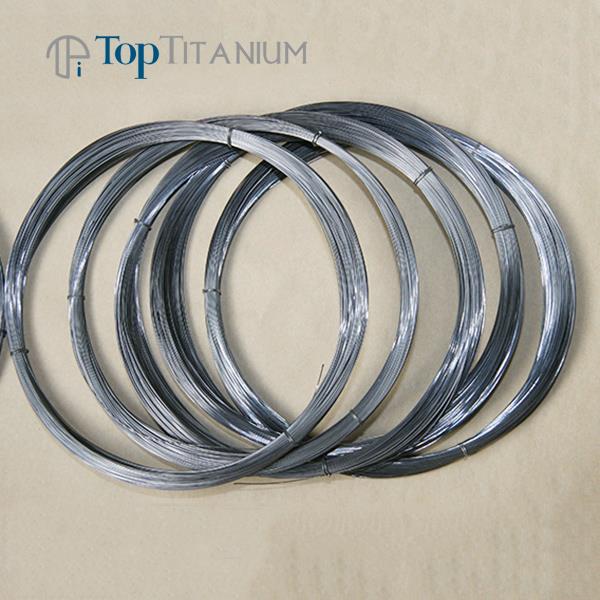

What's Pure Titanium Wire?
Pure titanium wire, as the name suggests, is made up of almost entirely titanium. We're talking about a metal that's over 99% titanium. This high purity gives it some unique properties.
First off, pure titanium is incredibly corrosion - resistant. It can withstand harsh environments, like those with high levels of saltwater or chemicals. That's why it's often used in marine applications, such as in the construction of boats or offshore platforms. You can also find it in the medical field, for things like dental implants and orthopedic devices. The human body has a great tolerance for pure titanium, making it a safe choice for medical use.
Another great thing about pure titanium wire is its low density. It's much lighter than steel, but still has a good amount of strength. This makes it ideal for aerospace applications. Think about it - in the aerospace industry, every ounce matters. Using pure titanium wire can help reduce the overall weight of an aircraft without sacrificing too much on strength.
However, pure titanium wire does have its limitations. It's not as strong as some of the titanium alloy wires. In applications where high strength is a must, like in high - performance automotive parts or heavy - duty machinery, pure titanium might not be the best option.
And What About Titanium Alloy Wire?
Titanium alloy wire is a bit different. Instead of being almost all titanium, it has other elements mixed in. These elements can include aluminum, vanadium, and a few others. The addition of these elements changes the properties of the wire significantly.
One of the main advantages of titanium alloy wire is its strength. By adding other elements, we can create an alloy that's much stronger than pure titanium. This makes it perfect for applications where high strength is required. For example, in the automotive industry, titanium alloy wire can be used in engine components. These components need to withstand high temperatures and extreme pressures, and titanium alloy wire can handle it.
Titanium alloy wire also has good heat resistance. Some titanium alloys can maintain their strength even at high temperatures. This makes them suitable for use in jet engines and other high - temperature applications. In a jet engine, parts need to work well under intense heat, and titanium alloy wire can do just that.
But, like pure titanium wire, titanium alloy wire also has its drawbacks. It's generally more expensive to produce than pure titanium wire. The process of adding and mixing the other elements is more complex, which drives up the cost. Also, the corrosion resistance of some titanium alloys might not be as good as that of pure titanium. In extremely corrosive environments, pure titanium might still be the better choice.
Applications Comparison
Let's take a closer look at some specific applications to see how these two types of wires stack up.
Marine Applications
In the marine environment, corrosion is a big concern. As I mentioned earlier, pure titanium wire has excellent corrosion resistance. It can be used in boat hulls, propellers, and other parts that are constantly in contact with saltwater. The Heat Exchanger Titanium Wire is also a great option for marine heat exchangers. These heat exchangers need to be able to resist corrosion while transferring heat efficiently, and pure titanium wire fits the bill.
On the other hand, titanium alloy wire might be used in areas where strength is also important. For example, in the structural components of a large ship, where the wire needs to support heavy loads.
Medical Applications
In the medical field, pure titanium wire is the go - to choice for many applications. Its biocompatibility makes it safe for use inside the human body. Dental implants, as I mentioned before, are a common use. The human body doesn't reject pure titanium, which is crucial for the long - term success of the implant.
Titanium alloy wire can also be used in some medical applications. For example, in orthopedic devices where a bit more strength is needed. But the choice between pure titanium and titanium alloy in the medical field often depends on the specific requirements of the device.
Aerospace Applications
As we've already discussed, both pure titanium and titanium alloy wires are used in the aerospace industry. Pure titanium wire's light weight makes it suitable for non - critical components where weight reduction is important. For example, it can be used in some interior parts of an aircraft.
Titanium alloy wire, with its high strength, is used in more critical components. In the wings and fuselage of an aircraft, where the wire needs to support the weight of the plane and withstand aerodynamic forces, titanium alloy wire is often the preferred choice.
Industrial Applications
In the industrial world, the choice between pure titanium and titanium alloy wire depends on the specific application. For general corrosion - resistant applications, like in chemical processing plants, pure titanium wire might be used. The ASTM Gr1 Gr2 Titanium Wire is a popular choice for these types of applications. It meets certain standards for purity and corrosion resistance.
In applications where high strength and heat resistance are required, like in power generation plants or heavy - duty machinery, titanium alloy wire is usually the better option.
Surface Treatments
Another aspect to consider is the surface treatment of the wires. We offer Black Surface Titanium Wire, which can be either pure titanium or titanium alloy. The black surface treatment can enhance the wire's properties in different ways.
For pure titanium wire, the black surface treatment can improve its corrosion resistance even further. It can also give the wire a more aesthetically pleasing look, which can be important in some applications.
For titanium alloy wire, the black surface treatment can help with heat dissipation. In applications where the wire gets hot, like in electronic devices, this can be a big advantage.
Conclusion
So, to sum it up, the main difference between pure titanium wire and titanium alloy wire lies in their composition and properties. Pure titanium wire is great for its corrosion resistance and light weight, but it's not as strong as titanium alloy wire. Titanium alloy wire, on the other hand, offers high strength and good heat resistance, but it's more expensive and might not have the same level of corrosion resistance as pure titanium in some cases.
If you're in the market for titanium wire, whether it's pure titanium or titanium alloy, we're here to help. We understand that every application is different, and we can work with you to find the right type of wire for your needs. Whether you're in the aerospace, automotive, medical, or any other industry, we've got the expertise to guide you.
If you're interested in learning more or making a purchase, don't hesitate to reach out. We're always happy to have a chat and discuss your requirements. Let's work together to find the perfect titanium wire solution for you!
References
- "Titanium: A Technical Guide" by John R. Davis
- "Materials Science and Engineering: An Introduction" by William D. Callister Jr. and David G. Rethwisch


