

Hey there! As a supplier of Titanium Hexagon Bars, I often get asked about the difference between forged and extruded titanium hexagon bars. It's a topic that can seem a bit technical at first, but I'm here to break it down in a way that's easy to understand.
What Are Forged Titanium Hexagon Bars?
Forging is a manufacturing process where metal is shaped by applying compressive forces. In the case of titanium hexagon bars, the forging process involves heating the titanium to a specific temperature and then using mechanical presses or hammers to deform it into the desired hexagonal shape.
One of the main advantages of forged titanium hexagon bars is their superior strength. The forging process aligns the grain structure of the titanium, which makes the bars more resistant to fatigue and stress. This is especially important in applications where the bars will be subjected to high loads or repeated stress, such as in aerospace or automotive industries.
Another benefit of forged bars is their excellent dimensional accuracy. Since the forging process uses precision dies, the final product can be made to very tight tolerances. This means that the bars will fit perfectly in the intended application, reducing the need for additional machining or adjustments.
However, forging is a relatively expensive process, and it can be time-consuming. The equipment required for forging is also quite large and complex, which adds to the overall cost. Additionally, the forging process can only produce bars within a certain size range, so it may not be suitable for very large or very small bars.
What Are Extruded Titanium Hexagon Bars?
Extrusion is a manufacturing process where a metal billet is forced through a die to create a specific shape. In the case of titanium hexagon bars, the billet is heated and then pushed through a hexagonal die to form the bar.
Extruded titanium hexagon bars are known for their high production efficiency. The extrusion process can produce long lengths of bars in a relatively short time, which makes it a cost-effective option for large-scale production.
Another advantage of extruded bars is their smooth surface finish. The extrusion process results in a bar with a uniform and smooth surface, which can be beneficial in applications where appearance is important or where the bar will be in contact with other components.

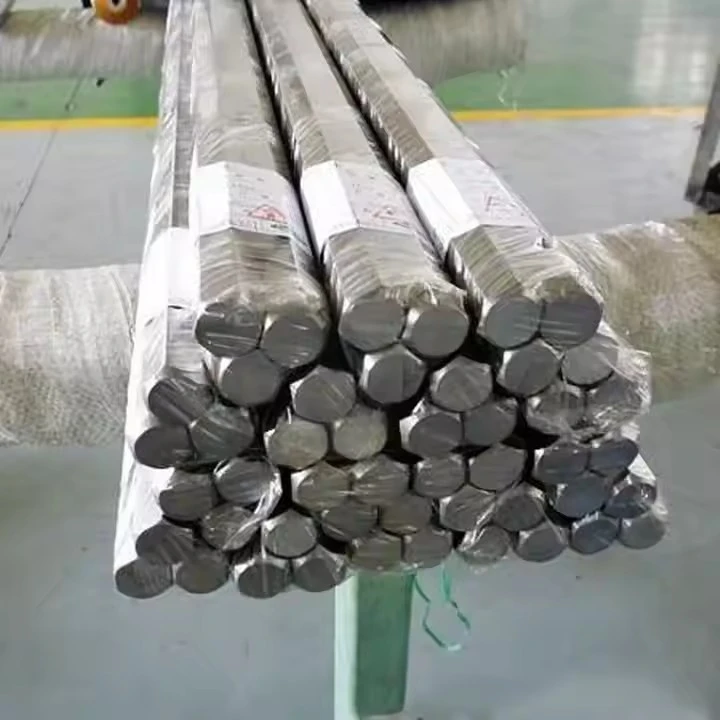
Extrusion also allows for greater flexibility in terms of the size and shape of the bars. It can produce bars with a wider range of cross-sectional shapes and sizes compared to forging. This makes it a good choice for custom or non-standard applications.
However, extruded bars may not have the same level of strength as forged bars. The extrusion process does not align the grain structure of the titanium as effectively as forging, which can result in slightly lower mechanical properties. Additionally, the dimensional accuracy of extruded bars may not be as high as that of forged bars, especially for very tight tolerances.
Comparing the Two
Now that we've looked at the characteristics of forged and extruded titanium hexagon bars, let's compare them side by side in some key areas:
Strength
Forged bars generally have higher strength due to the alignment of the grain structure during the forging process. They are better suited for applications where high strength and resistance to fatigue are required. Extruded bars, on the other hand, have lower strength but can still meet the requirements of many applications.
Dimensional Accuracy
Forged bars offer better dimensional accuracy, especially for tight tolerances. This is because the forging process uses precision dies. Extruded bars can have good dimensional accuracy but may not be as precise as forged bars, especially for complex shapes or very tight tolerances.
Surface Finish
Extruded bars typically have a smoother surface finish due to the nature of the extrusion process. Forged bars may have a rougher surface, although this can be improved through additional machining.
Cost
Forging is a more expensive process due to the high cost of equipment and the time-consuming nature of the process. Extrusion is generally more cost-effective, especially for large-scale production.
Production Efficiency
Extrusion is more efficient for high-volume production as it can produce long lengths of bars quickly. Forging is slower and more suitable for smaller production runs or applications where high strength is critical.
Applications
The choice between forged and extruded titanium hexagon bars depends largely on the specific application. Here are some common applications for each:
Forged Titanium Hexagon Bars
- Aerospace: In aircraft components such as landing gear, engine parts, and structural components where high strength and reliability are crucial.
- Automotive: For high-performance engine components, suspension parts, and racing applications where the bars need to withstand high loads and stress.
- Medical: In surgical implants and medical devices where the bars need to have excellent biocompatibility and strength.
Extruded Titanium Hexagon Bars
- Architectural: For building facades, handrails, and decorative elements where appearance and cost-effectiveness are important.
- Electronics: In electronic enclosures and heat sinks where the bars need to have good thermal conductivity and a smooth surface finish.
- General Manufacturing: For a wide range of applications where the bars do not require extremely high strength but need to be produced in large quantities.
Our Products
As a supplier of Titanium Hexagon Bars, we offer both forged and extruded options to meet the diverse needs of our customers. Our 348 Titanium Hexagon Bar is a high-quality product that is available in both forged and extruded forms. We also have Gr3 Titanium Hexagon Bar and Gr2 Titanium Hexagon Bar in various sizes and specifications.
Whether you need a small quantity of high-strength forged bars for a specialized application or a large volume of cost-effective extruded bars for a general manufacturing project, we can provide you with the right solution. Our team of experts can help you choose the best option based on your specific requirements and budget.
Conclusion
In conclusion, the main difference between forged and extruded titanium hexagon bars lies in their manufacturing processes, which result in different properties and characteristics. Forged bars offer higher strength and better dimensional accuracy but are more expensive and less efficient for large-scale production. Extruded bars are more cost-effective and efficient for high-volume production, with a smooth surface finish, but may have slightly lower strength.
If you're in the market for Titanium Hexagon Bars, I encourage you to reach out to us to discuss your needs. We're here to provide you with the best products and services to meet your requirements. Whether you're a small business or a large corporation, we can work with you to find the right solution for your project.
References
- ASM Handbook, Volume 14A: Metalworking - Forging
- ASM Handbook, Volume 14B: Metalworking - Extrusion and Drawing
- Titanium: A Technical Guide, Second Edition by John C. Williams


