

Short Introduction
Titanium alloy forgings are widely used in the important load-bearing parts of aircraft and aircraft engines because of their high specific strength, good medium temperature performance, corrosion resistance and good welding performance. According to statistics, the weight ratio of titanium alloy used in foreign airplanes has reached about 30%, which shows that titanium alloy has a broad future in the aviation industry
1.Details of Gr5 titanium block
|
Standard |
TC4 corresponds to GB / T16598-96, TI6AL4V corresponds to AMS 4928, Gr5 corresponds to ASTM B 381, and US military standard TI6AL4V corresponds to MIL-T-9047 |
|
performance |
Titanium forgings have high strength and small density, good mechanical properties, good toughness and corrosion resistance |
|
Status |
Annealed state (M) Thermal processing state (R) (annealed, supersonic flaw detection) |
|
Features |
1. Excellent resistance to corrosive and erosive action of high-temperature acid steam and brine, 2. High strength 3. High resistance to pitting, crevice corrosion resistance 4. High strength to weight ratio 5.Weight saving possibilities 6. Low modulus, high fracture toughness and fatigue resistance 7. Suitability for coiling and laying on seabed 8.Ability to withstand hot/dry and cold/wet acid gas loading |
|
Product Description |
Diameter customizable Technique Hot Forging Surface Smooth surface processing |
|
Application
|
industry, electronics, medical, chemical, petroleum, pharmaceutical, aerospace, etc. |
2. Chemical composition of Gr5 titanium block
|
Grade |
N |
C |
H |
Fe |
O |
Al |
V |
Pd |
Mo |
Ni |
Ti |
|
Gr5 |
0.05 |
0.08 |
0.015 |
0.40 |
0.20 |
5.5-6.75 |
3.5- 4.5 |
/ |
/ |
/ |
Balance |
3.Mechanical properties of Gr5 titanium block
|
Grade |
Tensile Strength, Min MPa |
Yield Strength Min MPa |
Elongation in 4D,Min, % |
Reduction of Area, min % |
|
Gr5 |
895 |
828 |
10 |
25 |
4.Specification of Gr5 titanium block
|
Product Name |
Dimensions |
Standards |
||
|
Outer Diameter |
Inner Diameter |
Height |
||
|
Disc |
50~200 |
/ |
20~140 |
ASTM B381 |
|
200~400 |
/ |
25~150 |
||
|
400~600 |
/ |
30~110 |
||
|
Ring |
200~400 |
100~300 |
20~150 |
|
|
400~700 |
150~500 |
30~250 |
||
|
700~900 |
300~700 |
35~300 |
||
|
900~1300 |
400~900 |
50~400 |
5.Defects of titanium alloy forgings
a.Segregation type defect
In addition to β segregation, β spot, titanium rich segregation and strip α segregation, the most dangerous is the interstitial α stable segregation (I-type α segregation), which is often accompanied by small holes and cracks, containing oxygen, nitrogen and other gases, and is brittle. There are also aluminum rich α stable segregation (type II α segregation), which also has dangerous defects due to cracks and brittleness, and will reduce the thermal stability and other properties of the alloy.
b. inclusions
There are inclusions on the surface of the blank, and cracks are often formed along the inclusions during forging, or obvious foreign matters appear after the corrosion of the forging, most of which are high melting point and high density metal inclusions. The high melting point and high density elements in titanium alloy are not fully melted and left in the matrix (such as molybdenum inclusion). There are also carbide tool chips mixed in smelting raw materials (especially recycled materials) or improper electrode welding processes (vacuum consumable electrode remelting method is generally used for titanium alloy smelting, such as high density inclusions left by tungsten arc welding ) , such as tungsten inclusions, in addition to titanium inclusions, etc., such titanium alloy forgings with inclusions are not allowed to be put into use.
c. holes
The holes may not exist alone, but may also exist in a number of dense, which will speed up the low cycle fatigue crack growth and lead to early fatigue failure.
d. crack
It mainly refers to forging cracks. Titanium alloy has large viscosity, poor fluidity, and poor thermal conductivity. Therefore, in the process of forging deformation, due to large surface friction, obvious internal deformation nonuniformity and large temperature difference between the inside and outside, it is easy to produce shear bands (strain lines) inside the forging. In serious cases, cracks occur along the direction of maximum deformation stress.
e. overheating
Titanium alloy has poor thermal conductivity. In addition to overheating of forgings or raw materials due to improper heating during hot working, it is also easy to overheat due to thermal effect during deformation during forging, resulting in microstructure change and overheating of Widmanstatten structure [iv].
In order to ensure the quality of titanium alloy forgings, in addition to strictly controlling the quality of raw materials, we should also pay attention to the ultrasonic testing of the forging blanks and semi-finished products to prevent some deformation and physical properties of the defects that will change in the subsequent heating process.
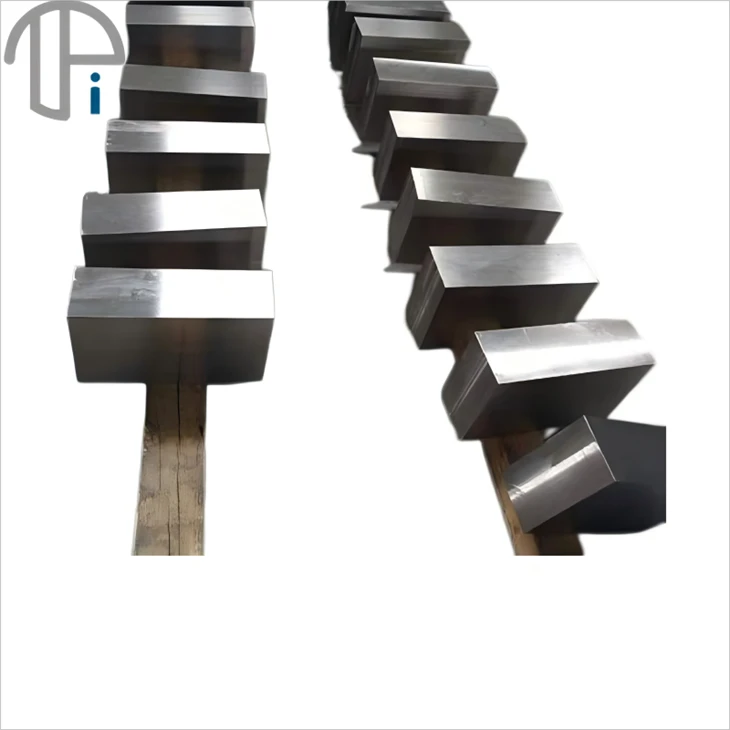
6.Photos of Gr5 Titanium Block
 |
 |
Hot Tags: gr5 titanium block, China gr5 titanium block manufacturers, suppliers, factory, 381 Titanium Block, Gr5 Titanium Block, Titanium Flange, 381 Titanium Disk, Gr2 Titanium Block, Titanium End Cap


