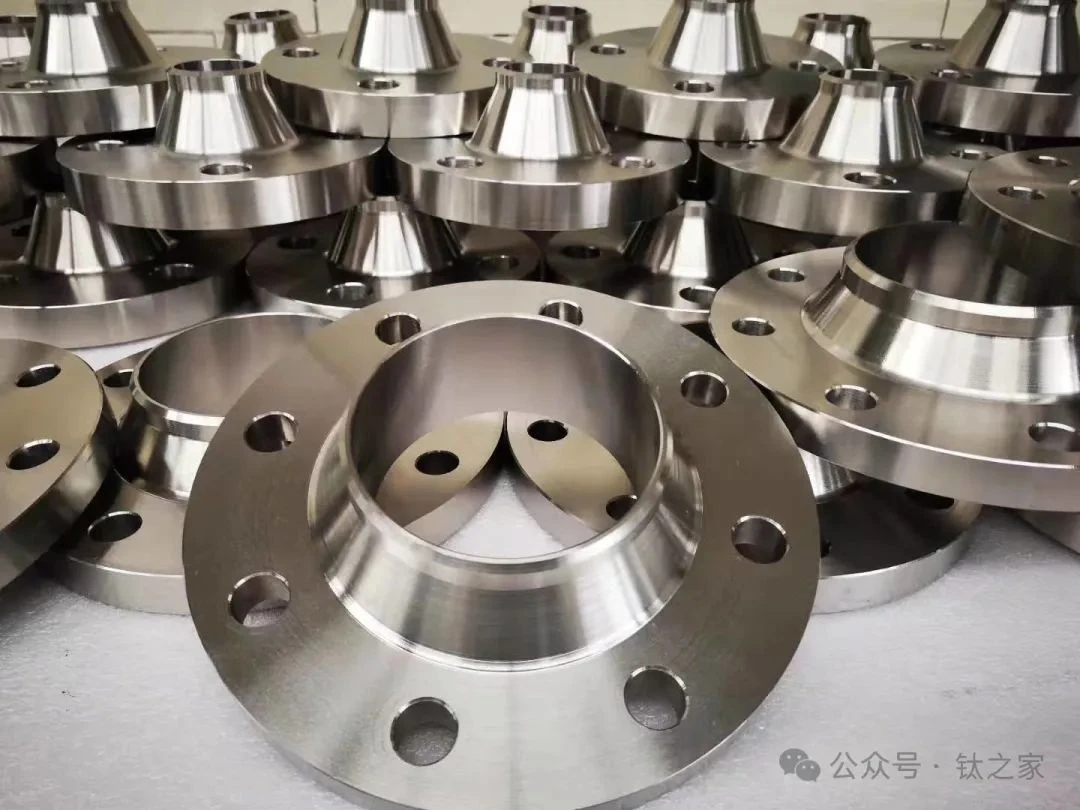
Titanium flanges, as an indispensable connection element in pipeline systems, provide a reliable connection solution for various industrial applications with their unique materials and excellent performance. This paper will define the titanium flange, structure,The manufacturing methods, applications and advantages are introduced in detail.
I. Definition and structure
Titanium flanges are made of titanium or its alloy and are used for placing two or more tubes in a component with interconnected ends. It has excellent strength-to-weight ratio, corrosion resistance, non-magnetic and biocompatibility, and stability at high temperatures. The disk structure of the titanium flange is provided with a through hole matching the inner diameter of the pipe, and the surface is distributed with a specific number, size and arrangement of holes, which are used to install bolts or double-ended studs to achieve tight fixation between flanges.
2. Manufacturing method and connection form
Titanium flanges are manufactured by a variety of methods, including precision casting processes, for complex internal structures or special performance requirements. The connection form, in addition to the traditional bolt connection, also includes threaded connection and welded connection. Threaded connection Small or application-specific flanges that can be threaded directly to pipes or other components. Welded connections are particularly suitable for applications that require extremely high sealing and structural strength, such as pressure vessels, chemical equipment or aerospace applications.
3. Application and advantages
Titanium flanges are widely used in pipeline systems in chemical treatment, petroleum refining, ocean engineering, electric power, medicine, food processing and other industries, especially for handling highly corrosive media. Its corrosion resistance, lightweight, biocompatibility and high temperature properties make it a leader in high-performance pipe connection components.
1) Corrosion resistance: The high corrosion resistance of titanium flange enables it to maintain long-term structural integrity and sealing reliability in harsh environments, significantly reducing maintenance costs and extending the service life of equipment.
2) Lightweight: Compared to traditional stainless steel or carbon steel flanges, titanium flanges have lower quality and are of great value for high-end applications that require weight reduction.
3) Biomedical field: Titanium's biocompatibility makes it a favorite in medical device manufacturing, which can be used to build pipe connections for medical devices or laboratory equipment implanted in the body.
4) High temperature performance: Titanium alloy can still maintain good mechanical properties and creep resistance under high temperature environment, suitable for high temperature and high pressure conditions.
4. Specification parameters and testing
The specification parameters of titanium flanges include nominal diameter, pressure grade, flange type, connection form, applicable standard and material grade. In order to ensure compliance with relevant standards and use requirements, the inspection of titanium flanges may include material composition analysis, dimensional inspection, non-destructive testing, mechanical property testing, sealing performance testing and surface quality assessment.
In short, titanium flanges, with their unique materials and excellent performance, provide a reliable connection solution for a variety of harsh environments and demanding applications, and are an indispensable high-performance pipe connection component in modern industry.