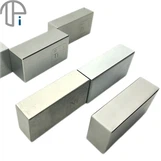
As a supplier of Gr23 Titanium Bar, I am often asked about the production process behind this high - performance material. Gr23 Titanium Bar, also known as Ti6Al4V ELI titanium bar, is a widely used titanium alloy in various industries, especially in aerospace. In this blog, I will take you through the detailed production process of Gr23 Titanium Bar.
Raw Material Preparation
The first step in producing Gr23 Titanium Bar is the preparation of raw materials. The primary components of Gr23 titanium alloy are titanium, aluminum, and vanadium, along with a small amount of iron and oxygen. The purity of these raw materials is crucial as it directly affects the quality of the final product.
Titanium sponge is the most common starting material for titanium production. It is produced through the Kroll process, which involves the reduction of titanium tetrachloride with magnesium. Aluminum and vanadium are added in the form of master alloys to ensure a uniform distribution of these elements in the final alloy. The raw materials are carefully weighed and mixed according to the specific composition requirements of Gr23 titanium alloy.
Melting
Once the raw materials are prepared, they are melted in a vacuum arc remelting (VAR) furnace. The VAR process is widely used in titanium production because it can effectively remove impurities and ensure a homogeneous alloy composition.
In the VAR furnace, an electric arc is struck between the electrode made of the raw material mixture and a water - cooled copper crucible. The heat generated by the arc melts the electrode, and the molten metal drips into the crucible. The entire process takes place in a vacuum environment to prevent oxidation and contamination of the titanium.
The VAR process is usually repeated at least twice to further improve the purity and homogeneity of the alloy. After the second melting, the ingot is ready for the next stage of processing.
Forging
The next step is forging. Forging is a crucial process that helps to refine the grain structure of the titanium alloy and improve its mechanical properties. The ingot is heated to a specific temperature, typically between 900°C and 1000°C, and then deformed using a forging press or hammer.
There are different forging techniques, including open - die forging and closed - die forging. Open - die forging is used to produce simple shapes such as bars and billets, while closed - die forging is used for more complex shapes. During forging, the ingot is gradually reduced in size and shaped into the desired form. The forging process is carried out in multiple steps, with intermediate reheating between each step to maintain the proper temperature for deformation.
Rolling
After forging, the titanium billet is sent for rolling. Rolling is a process that further reduces the cross - sectional area of the billet and produces a more uniform and precise shape. The billet is passed through a series of rolling mills, which gradually reduce its thickness and increase its length.
There are two main types of rolling: hot rolling and cold rolling. Hot rolling is carried out at high temperatures, typically above the recrystallization temperature of the titanium alloy. This allows for greater deformation and better control of the grain structure. Cold rolling, on the other hand, is carried out at room temperature and is used to improve the surface finish and dimensional accuracy of the bar.
During the rolling process, the titanium bar is also subject to various quality control measures. Non - destructive testing methods such as ultrasonic testing and eddy - current testing are used to detect any internal defects or inhomogeneities in the bar.


Heat Treatment
Heat treatment is an important step in the production of Gr23 Titanium Bar. It helps to optimize the mechanical properties of the alloy, such as strength, ductility, and toughness. There are different heat treatment processes, including annealing, solution treatment, and aging.
Annealing is a process of heating the bar to a specific temperature and then cooling it slowly. This helps to relieve internal stresses and improve the machinability of the bar. Solution treatment involves heating the bar to a high temperature to dissolve the alloying elements in the titanium matrix and then quenching it rapidly to retain the supersaturated solid solution. Aging is a subsequent process where the solution - treated bar is heated to a lower temperature for a certain period of time to precipitate fine particles that strengthen the alloy.
The specific heat treatment parameters, such as temperature, time, and cooling rate, are carefully controlled based on the desired properties of the Gr23 Titanium Bar.
Machining and Finishing
After heat treatment, the Gr23 Titanium Bar may undergo further machining and finishing operations. Machining processes such as turning, milling, and drilling are used to produce the final dimensions and surface finish of the bar.
The surface of the bar is then finished using various methods, such as grinding, polishing, or shot peening. Grinding is used to remove any surface imperfections and achieve a smooth surface finish. Polishing can further improve the surface quality and appearance of the bar. Shot peening is a process that involves bombarding the surface of the bar with small metal or ceramic particles to induce compressive stresses and improve the fatigue resistance of the bar.
Quality Control
Throughout the entire production process, strict quality control measures are implemented to ensure that the Gr23 Titanium Bar meets the required standards and specifications. Chemical analysis is carried out to verify the alloy composition, and mechanical testing is performed to determine the mechanical properties of the bar.
Non - destructive testing methods, as mentioned earlier, are used to detect any internal defects. In addition, visual inspection is also carried out to check for surface defects such as cracks, scratches, and porosity. Only the bars that pass all the quality control tests are considered suitable for use in various applications.
Applications of Gr23 Titanium Bar
Gr23 Titanium Bar has a wide range of applications due to its excellent mechanical properties, corrosion resistance, and biocompatibility. One of the most important applications is in the aerospace industry. Titanium Bar for Aerospace is used in the manufacture of aircraft components such as landing gear, engine parts, and structural frames. The high strength - to - weight ratio of Gr23 titanium alloy makes it an ideal material for these applications, as it can reduce the weight of the aircraft and improve its fuel efficiency.
In the medical field, Ti6AL4V ELI titanium bar is used in the production of orthopedic implants and dental prosthetics. The biocompatibility of Gr23 titanium alloy ensures that it can be safely used in the human body without causing any adverse reactions.
It is also used in the marine, automotive, and chemical industries. In the marine industry, Gr23 Titanium Bar is used in the construction of ship components due to its excellent corrosion resistance in seawater. In the automotive industry, it is used in high - performance engine parts and suspension components. In the chemical industry, it is used in equipment that is exposed to corrosive chemicals.
Conclusion
The production process of Gr23 Titanium Bar is a complex and precise process that involves multiple steps, from raw material preparation to finishing and quality control. Each step is crucial in ensuring the high quality and performance of the final product.
As a supplier of Gr23 Titanium Bar, we are committed to providing our customers with high - quality products that meet their specific requirements. Our products are widely used in various industries, and we have a reputation for reliability and excellence.
If you are interested in purchasing Gr23 Titanium Bar or have any questions about our products, please feel free to contact us for a procurement discussion. We look forward to working with you and meeting your titanium bar needs.
References
- ASM Handbook, Volume 2: Properties and Selection: Nonferrous Alloys and Special - Purpose Materials.
- Titanium: A Technical Guide, Second Edition by J. C. Williams.
- "Production of Titanium Alloys" in the Journal of Materials Processing Technology.