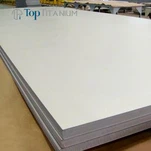
Titanium Plate for Architecture Introduction
Titanium has high strength and excellent welding performance, and has a small density and excellent corrosion resistance. It is most suitable for roofs and walls of buildings. Titanium alloy has high strength and is used in various supports and beams of buildings.
1.Introduction of titanium plate for architecture
Titanium has high strength and excellent welding performance, and has a small density and excellent corrosion resistance. It is most suitable for roofs and walls of buildings. Titanium alloy has high strength and is used in various supports and beams of buildings. Recently emerging methods and technologies that go beyond stainless steel are used in shear, forming, and joining titanium. Titanium can be connected with components using a universal TIG welding process, and the self-healing oxide film of titanium can prevent welding from being damaged.
2. Chemical composition of titanium plate for architecture
|
Grade |
N |
C |
H |
Fe |
O |
Al |
V |
Pd |
Mo |
Ni |
Ti |
|
Gr1 |
0.03 |
0.08 |
0.015 |
0.20 |
0.18 |
/ |
/ |
/ |
/ |
/ |
Balance |
|
Gr2 |
0.03 |
0.08 |
0.015 |
0.30 |
0.25 |
/ |
/ |
/ |
/ |
/ |
Balance |
|
Gr5 |
0.05 |
0.08 |
0.015 |
0.40 |
0.20 |
5.5- 6.75 |
3.5- 4.5 |
/ |
/ |
/ |
Balance |
|
Gr7 |
0.03 |
0.08 |
0.015 |
0.30 |
0.25 |
/ |
/ |
0.12- 0.25 |
/ |
/ |
Balance |
|
Gr9 |
0.03 |
0.08 |
0.015 |
0.25 |
0.15 |
2.5- 3.5 |
2.0- 3.0 |
/ |
/ |
/ |
Balance |
|
Gr12 |
0.03 |
0.08 |
0.015 |
0.30 |
0.25 |
/ |
/ |
/ |
0.2- 0.4 |
0.6- 0.9 |
Balance |
|
Gr23 |
0.03 |
0.08 |
0.012 |
0.25 |
0.13 |
5.5- 6.5 |
3.5- 4.5 |
/ |
/ |
/ |
Balance |
3.Mechanical properties of titanium plate for architecture
|
Grade |
Tensile strength MPa (min) |
Yield strength, MPa (min) |
Elongation, % (min) |
Bend Test |
|
|
Under(1.8mm) in Thickness |
Under(1.8-4.75mm) in Thickness |
||||
|
Gr1 |
240 |
138-310 |
24 |
3T |
4T |
|
Gr2 |
345 |
275-450 |
20 |
4T |
5T |
|
Gr3 |
450 |
380-550 |
18 |
4T |
5T |
|
Gr4 |
550 |
483-655 |
15 |
5T |
6T |
|
Gr5 |
895 |
828 |
10 |
9T |
10T |
|
Gr7 |
345 |
275 |
20 |
4T |
5T |
|
Gr9 |
620 |
483 |
20 |
4T |
5T |
|
Gr23 |
828 |
759 |
10 |
9T |
10T |
4.Method for changing color on titanium alloy bar

The oxide film of titanium is formed by the surface of titanium metal reacting with air / water. Compared with the surface of stainless steel and aluminum, the outstanding corrosion resistance of titanium is exactly this layer of oxide film. The different colors of the titanium surface depend on the different thickness of the oxide film (<10nm, silver; 12nm, gold; 20nm, brown; 35nm, blue). By adjusting the thickness of the oxide film and the surface gloss of the titanium material, the surface of the titanium material used in construction can have a colorful appearance.
The surface structure of titanium materials for construction is diverse, ranging from soft, rough to shiny surfaces. After anodizing, its color and gloss will not fade, and the oxide film will thicken. In this way, the rainbow principle due to the interference of light Color is generated. When light passes through this layer of oxide film, part of it will be reflected, part of it will be refracted, and part of it will be absorbed. The phase of the reflected light will be different, and the interference surface will show different colors. In order to maintain the color of titanium when used in buildings, In the actual production, the surface gloss control technology should be considered, that is, the adjustment of the annealing and pickling conditions can be feedback from the gloss monitoring device to adjust the annealing (temperature, time) and pickling (temperature, time, acid ratio) .

5.Why choose titanium plate for architecture
1.As a building material, titanium not only has a natural luster, but also can show different colors through oxidation. In addition, it has excellent corrosion resistance, and does not need to be coated with an anticorrosive film. Because the titanium material has a small reflectance and has a light silver gray , So its natural color is satisfactory. After annealing and pickling, the surface of titanium is shiny.
2. Adopt the method of anodizing the metal and adjusting the natural gloss of the surface before oxidation to change the hue to meet the customer's color requirements.

6.Countries where titanium plates are widely used in construction

Japan

The United Kingdom

France

the United States
Commonly used countries for titanium plate construction
Spain
the Netherlands
Canada
Belgium
Japan is the first country to apply titanium to buildings, and it is also the country that uses the most titanium on buildings. It is mainly used on the roof of buildings, followed by building curtain walls, harbor facilities, bridges, undersea tunnels, outer walls, and decorative objects , Small accessories, pillar decoration, exterior decoration, monuments, signs, doorplates, railings, pipes, anti-corrosion coating, etc.
The United Kingdom, France, the United States, Spain, the Netherlands, Canada,and Belgiumall have examples of buildings using titanium metal for roofs and curtain walls. Sweden, Singapore, and Egypt have begun to use titanium in some new buildings. In 1997, the Guggenheim Museum in Bilbao, Spain, used titanium metal plates to construct curved surfaces. Abu Dhabi Airport has also selected titanium, and the amount is nearly 100 tons. The airport is the first in the world to use titanium as a building structural material.
Hot Tags: titanium plate for architecture, China titanium plate for architecture manufacturers, suppliers, factory, Titanium Strip in Coil, Gr5 Titanium Plate, ASTM B265 Titanium Sheet, titanium plate for chemical, Grade 2 Titanium Sheet, Medical Cannulated Titanium Bar